The left bank

Flower clock - Rousseau island

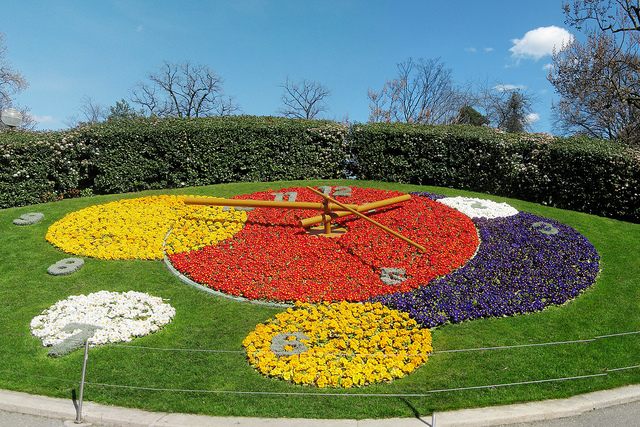
A symbol of the renowned worldwide Geneva watch industry, the famous flower clock, located at the edge of the Jardin Anglais (English Garden) since 1955, is a masterpiece of technology and floral art.

Formerly only decorative with its sole dial comprising over 6,500 flowers, the new millennium provided it with decisive artistic dimensions thanks to the ingenuity of the gardeners of the Service of Green Spaces and the Environment. It is now composed of eight circles, the colours of which vary with the seasons and the plants which make up the display. 

Did you know that the second hand of Geneva's Flower Clock is the largest in the world (it is more than 2.5 meters long)!

Not so far from here, you will find the Rousseau Island. For Geneva, Rousseau Island is a symbolic place with a very special view of the city. This ancient fortress at the start of the Rhône is today a green haven of relaxation. An imposing statue represents Rousseau, the philosopher of the Age of Enlightenment.

The island was not always a romantic place. It has a military history. At the end of the 16th century, it was a bastion of the city, surrounded by walls. In 1628, the island was used as a shipyard and was named Île des Barques (Boat Island). When the Pont des Bergues was built and connected to the island by a footbridge in 1832, it was finally named after the ‘citizen of Geneva’, Enlightenment philosopher and writer Jean-Jacques Rousseau. At the same time, the island was turned into a public park and decorated with a statue of the great man, sculpted by James Pradier.

Location: Quai du Général-Guisan (Jardin Anglais), 150m away from the hotel
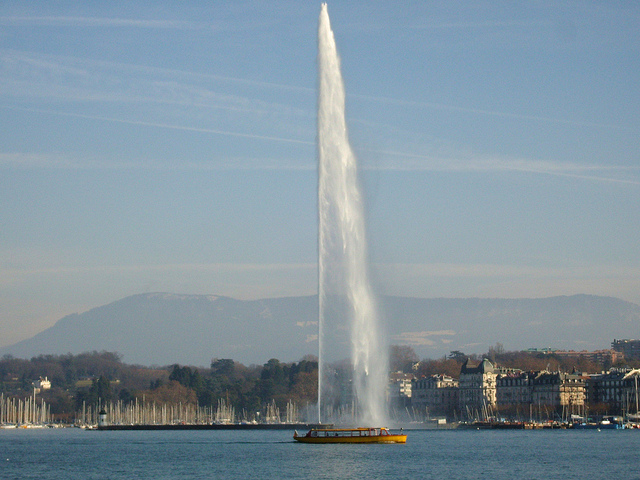
Water fountain

Originally a simple security valve at the Coulouvrenière hydraulic factory, this water fountain has, over the years, grown to be the symbol of Geneva.

In 1891, it was transferred to the "Rade", to become a major tourist attraction. However, it was not until 1951 that it was provided with an autonomous pumping station, propelling 500 litres of water per second to a height of 140 meters at a speed of 200 km per hour (124 miles/h).

Eight 9,000-watt projectors light the fountain’s majestic column in the evening as it soars skywards.

Location: Quai du Général-Guisan, 500m away from the hotel

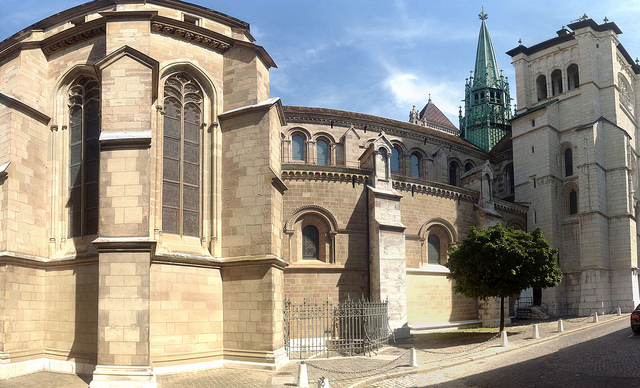
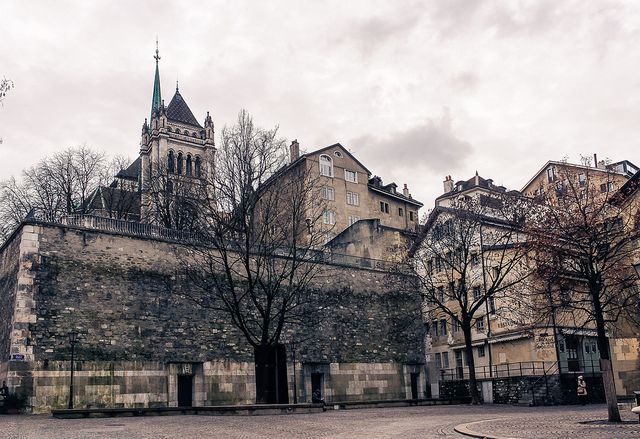
Saint Peter's Cathedral

One hundred fifty seven steps lead to the summit of the cathedral’s north tower and to a fabulous panorama overlooking the city and the lake.

You will also be charmed by the Clémence, the queen of the bells, weighing over 6 tons and hoisted to this very tower in 1407. The first phase of the cathedral’s construction dates back to the year 1160 and lasted nearly a century. Many events, including a series of fires, led to restorations and reconstructions, modifying its original design.

Then, in the middle of the 16th century, the advent of the Reformation, with its philosophy of austerity, upset the entire interior of the building. All ornaments were removed and the colored decors whitewashed. Only the stained glass windows were spared. Its current neo-classic facade dates from the middle of the 18th century, having replaced the former Gothic one.

Location: Cour Saint-Pierre, 450m away from the hotel

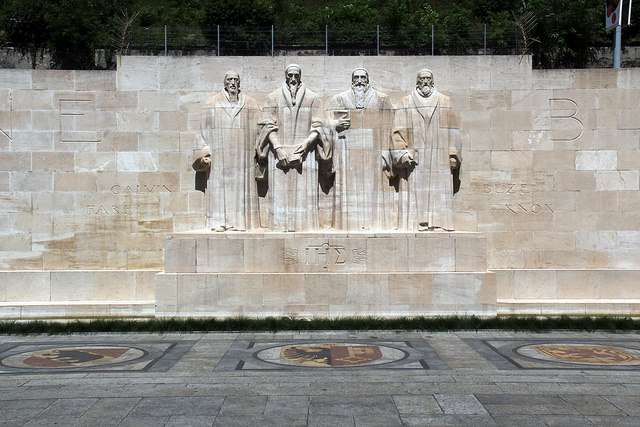
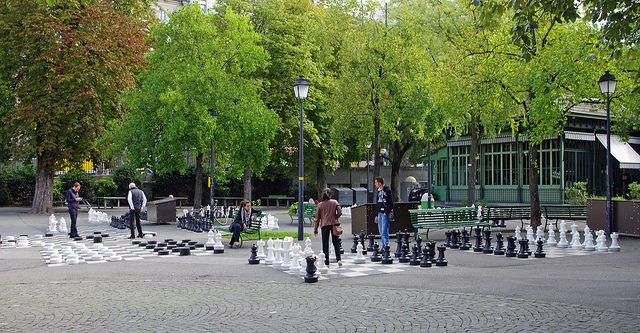
Reformation Wall - Parc des Bastions

Located below the Old Town, the Parc des Bastions is a large green area in the city centre. The park is the site of Geneva’s first botanical garden. You can admire the famous Reformation Wall.

The construction of the Reformation Wall in the Bastions Park began in 1909, the year which marked the 400th anniversary of the birth of Jean Calvin and the 350th of the foundation of the Academy of Geneva. The monument is backed against part of the ancient defensive walls that surrounded the city until the middle of the 19th century.

At the centre of the wall, five meters high, are the four great figures of the movement: Guillaume Farel (1489-1565), one of the first to preach the Reformation in Geneva, Jean Calvin (1509-1564) the "pope" of the reformers, Théodore de Bèze (1513-1605), first rector of the Academy and John Knox (1513-1572), founder of Presbyterianism in Scotland.Behind these statues stands the motto of the Reformation and of Geneva: "Post Tenebras Lux". On either side, statues and bas-reliefs represent the great Protestant figures of the different Calvinist countries and the crucial moments in the development of the movement.

Stroll along 100 meters of wall and cover 450 years in the history of Protestantism.

Location: Parc des Bastions, 800m away from the hotel

Place de la Madeleine

The wooden horses of the old merry-go-round on this colorful square at the foot of the Old Town have long been the delight of small children.

However, this place is historically significant by its famous Temple de la Madeleine which played a major role in the Reformation, and calls to mind names such as Jean Calvin, Guillaume Farel or Michel Servet.

This 15th century church was restored in the 17th century after having been devastated by fire. Several religious constructions had previously occupied the site, the oldest dating back to the 5th century. The interior is austere but has very beautiful modern stained glass windows.

Location: Place de la Madeleine, 100m away from the hotel

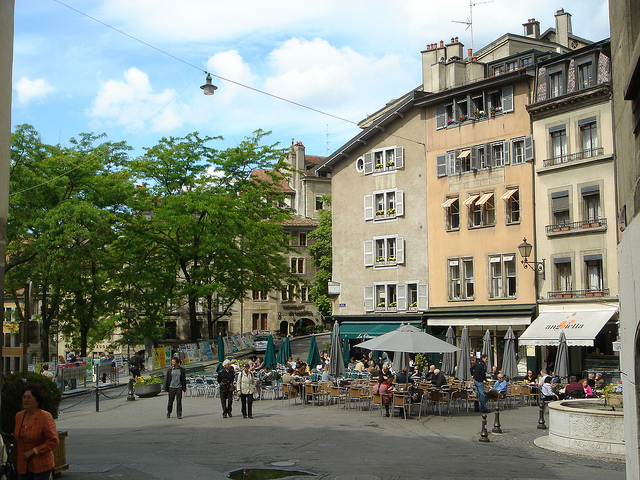
Place du Bourg-de-Four

In the very heart of the Old Town, the Place du Bourg-de-Four has always been a meeting place. Still today, hosts of Genevans gather around its lovely 18th century flowered fountain or on the terrace of a picturesque bistro. Since Roman times, it was a centre for commerce. In the middle of the 16th century, the houses were raised in order to accommodate exiled Protestants.

Today, one may admire magnificent specimens of 16th century architecture, as well as handsome constructions of the 17th and 18th. Also note the 18th century facade of the Palais de Justice (courthouse) in which yet older buildings sheltered, in turn, the convent of the Order of St. Clare and, until 1857, a hospital.

Location: Place du Bourg-de-Four, 400m away from the hotel

Place de Neuve

Built outside the former ramparts, the Place de Neuve has become the focal point of Genevan culture.

It comprises the Grand-Théâtre (opera), the reputed Conservatory of Music and the Rath Museum, internationally renowned for its temporary exhibitions. In the centre of the square, a statue depicts the Genevan general Henri Dufour, national hero and first to establish a map of Switzerland.

Location: Place de Neuve, 1km away from the hotel

Carouge

Carouge, a small suburb of Geneva, was only to develop after 1754, when it was granted to the Kingdom of Sardinia.

A city plan then was designed by Turinese architects with a checkerboard arrangement around an axis planted with trees (the Place du Marché) and low houses with galleries in the rear opening on gardens.

To this day, the city of Carouge has retained its Mediterranean-like atmosphere. Its bustling streets and many shaded squares invite one to stroll. Trendy boutiques, antiques and curios dealers, restaurants and bistros ensure a very warm and congenial ambience.

Location: Carouge, 3km away from the hotel

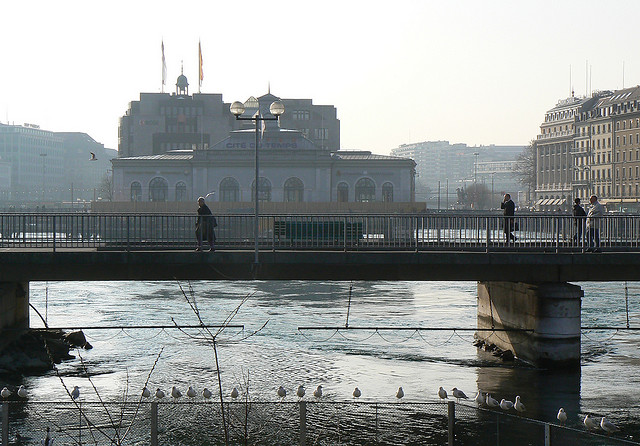
Pont de la Machine

The Pont de la Machine building was built in 1840 as a pumping station, to pump water for a new public fountains. Later it was rebuilt into a power station and was used to regulate the level of the river Rhône.

Since 1995 the Seujet dam is holding this function and The Pont de la Machine building is used for completely different purposes: as an Tourist Information Center, or Tourist Information Space as they call it, among other functions.